Showing posts with label Travel. Show all posts

Monday, June 1, 2015

Mono Lake, CA

Amazing Storm over Mono Lake, California
Amazing Rain Storm over Mono Lake, CA

Mono Lake, Tufa Area

Last month is spend a weekend in the Sierra Nevada visiting Lake Tahoe and the Eastern Sierra, Mono Lake.  As I have traveled to Lake Tahoe quite frequently in May, I was not surprised by the late season snow fall that blanketed the higher elevations (>6700 ft) with fluffy new snow.

From there I drove to the Owens Valley in the Eastern Sierra to visit the Ghost Town Bodie and then Mono Lake.

Today, I want to share some amazing images made at Mono Lake late in the afternoon when a storm passed over and 'got stuck' over the northern part of the Mono Lake Basin.  Heavy rain made for curtains of rain visible from the shores of the Lake at the Tufa Area.
Needless to say that my plans for star trails over Mono Lake were foiled but what a great reward to be able to capture these amazing images!


Heavy rain on the other side of the Lake


Storm clouds over the Sierra


The rain clouds just never made it over the pass at the northern end of the Lake


A Glimpse of Sunset over the Eastern Sierra


Finally, a bit of light over the eastern end of the Lake before the clouds turned around heading for the southern shore.

Although I had come to capture the stars in the sky, I was not disappointed with my evening at Mono Lake.  What a fantastic storm!  When the rain-laden clouds moved over the southern end of the Lake, it was time to leave.  Most of my fellow photographers, and there were quite a few,  packed up trying to avoid being soaked.  The small community of Lee Vining close by offered a late meal and a well-deserved glass of beer!

Cheers!
Til next time,
Meggi


Monday, August 18, 2014

Golden Gate Under Low Clouds


Golden Gate shrouded in low-hanging summer clouds

The best laid plans....

It was supposed to be an evening with great night photography at the Golden Gate during the blue hour, Palace of Fine Art and later at the Bay Bridge to see the moon rising in the late evening.  I had made these plans for an out-of-town visitors to whom I already explained that the city experiences more of a winter cold wind and fog during our summer days.  As I drove up on 280, the ominous clouds were unmistakable in the early afternoon pushing in from the ocean over the sunset district of the city.  From the high point at Divisadero, the business district was bathed in sunshine with only puffy clouds making it that far into the Bay.  As the afternoon proceeded the low cloud overcast pushed more and more over the city and into the Bay.

View through the North Tower from Battery Spencer

I hadn't been on Hawks Hill on a Saturday late afternoon in August - and the vista points along the road were not just packed but there was chaos on the road with the parking lots overloaded.  Walking up to Spencer Battery, we were greeting by fierce wind funneling into the Bay.  The tip of the Golden Gate towers previously still visible were progressively swallowed in clouds with more fog rolling in.  Timing our arrival before sunset, any hopes to catch the blue hour with the light coming on were blown in the wind or swallowed in fog!

It was time for alternative options!  By now the cloud cover extended pretty much all the way into the bay and maybe Fort Baker on the East side of the bridge would give us a better view.  Sandwiches, hot tea and granola bars bridged the time until the light fell.

Golden Gate shrouded under a low cloud ceiling

With all the moisture in the air, the warm colors of the night were reflected in the water.

Next alternate stop was the Palace of Fine Art with its reflection pond that invites any night photographer to stop and linger.

Palace of Fine Art

Forgetting moon rise at the Bay Bridge (!) our next stop was at the Legion of Honors.  I had photographed there in the past and experienced a nice reflection in the pond, but tonight the fountain was going giving us a different experience.

Legion of Honor

Horse and Rider Sculpture at the Legion of Honor

As midnight approached, I bid good bye to my friends.  Although I had planned quite a different evening the city of course offers many wonderful sights during the day and the night, and  I was happy that we captured some nice images at these alternate locations.

By now, Bill and Russ are back in the Midwest, but I am sure they will come back during the winter time when the skies are clear and we again can go out, and this time hopefully can capture the Golden Gate in 'better light" during the blue hour and into the night.

Until then, happy travel wherever your journey takes you!

Meggi


Tuesday, June 4, 2013

Night over Bixby Bridge

Star Trails over Bixby Bridge
 - and Photo Tips

Bixby Bridge on Highway 1, CA, USA

In the summer, the California coast is typically foggy at the end of the day and catching the night sky this time of the year is a rare treat.  But the weather forecast predicted an inversion when the warm air mass from the inland areas pushes towards the coast keeping the fog at bay.


On May 31, the forecast was for such an off-shore wind with the promise of a clear night at the coast.  So, I packed my gear and headed out to photograph the historic Bixby Bridge at night.  The bridge offers a well worth daytime destination and even on a Friday afternoon, many cars stopped, people jumped out, took some photos and headed on to whatever their final destination was.

California Coast

I had come early to explore the surroundings by daylight since photographing the bridge towards the water and southern sky required getting off Highway 1 and heading for the hills on a dirt road.  I walked up with my small camera taking images along the way to see which spot offered the best vintage point.

Bixby Bridge

Then I enjoyed sunset over the ocean sitting back to wait for the stars to come out.  A bit of haze covered the ocean but the sky overhead seemed fairly clear.

Early Evening haze

Sunset over the Ocean


I have learned that when setting up for a night shoot it is always good to get to the favorite spot before darkness.  So I drove up to “my spot” only to find 2 other cars and 5 guys rearing up to jump from the bridge – yes, you read correctly, these young men planned to jump with parashoots from the bridge and they did!  All of this happened so fast that I only couldn’t get a shot as they vanished into the void beneath. I am not sure about the heights of the bridge but it is a long way down [280ft / 85m according to Wikipedia] About ½ hour later they had climbed up the gulch to their cars and after much laughter they were heading for Santa Cruz for a Friday night party on the beach.

As I was setting up my tripod, checking the setting of my camera for the star trails, a highway trooper pulled up next to my car asking me about ‘bridge jumpers’.  How did he know?  The happy guys were long gone?  He said they were always concerned for the safety of the jumpers and after a quick thinking on how to respond, I assured him that the guys were healthy and happy as they left.

The Blue Hour
Camera settings during the ‘blue hour’ right after sunset:   f/2.8;  1 second, ISO 400; lens at 17mm.

As night fell, this unusual clear evening proved to be the rare treat I had hoped for.

With sunset pretty late, I had to wait until after 9pm for the stars to come out but what a great night it was.  Not much wind and mild temperatures - however, experience has taught me never to leave my house without my trusted down jacket, hat and gloves, and a thermos of hot tea!

Once the stars were out, I let the camera do its job for the next hour+ and record the stars.  Even with the haze increasing the stars still sparkles in the sky and I let the calm of the night envelop me.

Star Trails over Bixby Bridge [looking south with the rotation around the Southern Cross]

2 hours later, this is my last images of the evening with millions of stars overhead.  And a ghostly glow from the cars as they rounded the next hillside.  

Midnight over the Ocean
Camera Settings:  f/2.8;  30 sec,  ISO 2000, lens at 17mm  (a bit of lightening in post-processing)

Driving home way after midnight, I couldn’t wait to see what my camera captured and voila – I am sharing it with all of you.

If you are inspired, go out at night and see how beautiful the night sky can be outside the city lights.  Please also watch for upcoming Photo Workshops on my Photo Workshop link and enjoy the Photo tips below.

Til next time,
Meggi.


Photo Tips:

Over the past 2 year I have learned a lot for some great night photographers, astro-photographers, astrolandscapephotographers, and others that love the night and I am thankful to Steven Christenson, Star Circle Academy, and Jon Fuller, Moab Photo Tours, for their insight and help.  For those who have never ventured out under the “dark sky” - not city sky – here are some tips to make beautiful night images:

  1. A sturdy tripod is a must;
  2. A DSRL that can be set to manual focus and to manual exposure since the ‘automatic’ settings are completely fooled at night.
  3. A cable release since any camera shake will blur your image with long exposure.
  4. Loaded batteries and extra batteries.  Memory cards.
  5. Any lens can capture the night but for the night sky, a wide angle lens is best to capture as much in your view finder as possible and still be able to compose with some landscape into the frame to make the image more interesting.
  6. Exposure:  to capture as much of the little light available, expose with a wide open lens at f/4 or wider.
  7. Shutter speed:  Due the earth rotation, the stars seem to move and thus an exposure above 30 seconds will give oval stars.  Thus, my shutter speed will be between 20-30 sec for capturing the night sky (star points).
  8. Due to the improved sensitivity of the newer DSLRs, the ISO can be set high, e.g. between 1600-3200, to allow enough light to be recorded for a starry night sky image.
  9. In camera noise reduction:  set to off! Specifically for star trails since the camera would take another ‘dark’ image for the same length of time, e.g. 20-30 second, during which no recording takes place when shooting continuously.
  10. To preserve battery power, turn off the ‘image review’ function.
  11. The last images above was taken at around midnight at the following settings:  :  f/2.8;  30 sec,  ISO 2000 (a bit of lightening in post-processing)


Tuesday, March 19, 2013

Patagonia - El Chalten Wine Bar


Patagonia – El Chalten, 
a village at the foot of the FitzRoy Mountains 

A visit to La Vineria, an unexpected, amazingly well-stocked and sophisticated Wine Bar. 

[Part 3 of my Patagonia Journey]


When I checked Wikipedia, here is what is said about the small community:


"El Chaltén is a small mountain village in Santa Cruz Province, Argentina. It is located in the riverside of Río de las Vueltas, within the Los Glaciares National Park (section Reserva Nacional Zona Viedma) at the base of Cerro Torre and Cerro Fitz Roy mountains, both popular for climbing. For this reason this village is well-visited by trekkers and climbers.

The village was built in 1985 to help secure the disputed border with Chile. Today the sole reason for its existence is tourism. It is 220 km north of El Calafate.

"Chaltén" is a tehuelche word meaning smoking mountain, as they believe it was a volcano for its peak is most of the time covered by clouds. Other visited tracks and sights are Torre Glacier, Laguna Capri, Piedras Blancas Glacier, Chorrillo del Salto and Laguna de los Tres.


The village provides national park information for visitors, as well as commercial camping (with showers) and a very limited number of beds, catering mostly for backpackers. On the treks outside of the village free campsites are provided. There are two automated teller machines and relatively no cell phone service. The tourist trade has spawned a few restaurants and shops in town, with a large variety of outdoor equipment for sale, while some of the accommodations provide internet and phone access and show regular movies. Other than that, the town is fairly far removed from the normal flow of news and communication, even during high season (November–February). The town is nearly deserted during off-season (the southern hemisphere winter).

Climate:  El Chaltén has a dry -yet unpredictable- climate, with light precipitation distributed on a large number of days: despite the semi-arid setting, bad weather is exceedingly common. Summers experience long daylight hours, very windy weather, and cool temperatures, mostly below 18ºC (65F) during the day and below 5ºC (41F) during the night. Frost can and does occur in the summer too. Winters bring snow in moderate quantities, and average temperatures around 3ºC (37F) during the day and -4ºC (25F) during the night; however, the coldest nights are much colder than this. Spring and fall are variable, but generally cold as well."

Well, the village of El Chalten is still far away from any other towns.  During our 220 km drive north from El Calafate we only saw signs for the occasional ranch (Estancias) along the way.  But much has changed in the village over the last decade since tourism has increased and with it the number of guesthouses and hotels.  Now, modern accommodations for the non-trekking traveler are sprouting up all over the village, and we stayed in a very nice western standard hotel.  Small restaurants offered excellent food and the local Pizzeria tells of the northern influence.  But what was really surprising is that El Chalten has a wine bar stocked with a wide variety of Argentinian and Chilean wines.  One afternoon, our group was invited to sample a large number of different wines each accompanied by recommended food matching in character and complimenting the bouquet of the wine.  To find such a sophisticated place here in a place that one could classify as ‘at the end of the world’ is amazing.

The Wine bar sported an amazing number of different wines.

Elegant decorum


Are those the tastes that go with wine?

Ready for more tasting

Tish is admiring the wall of wine bottles from Argentina and Chile

Ready for the next round


Our Group of 15 sure filled the small wine bar.

Tasty morsels before the next wine.

Even as far south as El Calafate, where the climate is cold most of the time, wine is grown and prepared.

Cheese to clear the palette between the different flavors.

Ed and Pat waiting for the next sample.

Some of us walked back to the hotel under a beautiful sky with the FitzRoy Mountains slowly sinking into the night.  Another successful day on my journey in Patagonia.

Til next time,
Meggi

Torre Ceres and FitzRoy Mountains in last light


Part 1:  Patagonia - Overview of my Journey is linked here.
Part 2:  Patagonia - Glaciers and Rugged Mountains is linked here.

Comments?  I love to hear from you.  Please use my email mraeder33@gmail.com to reach me.

Sunday, March 3, 2013

Patagonia-2013


Patagonia and Magellan Strait
Argentina and Chile, South America

Today, on my birthday, I am back at home and will celebrate with friends and family. 

However, the last 4 weeks I traveled far from home and explored Patagonia and the southern region of the South American continent.

Overview of my Journey:

My journey took me from San Francisco to Buenos Aires in Argentina – albeit not in a straight line fashion as indicated on the above map.  Painfully, I had to go through New York before the night flight to the capital of Argentina.  But traveling with my good friend Lynda made the long flight and layovers bearable.

After a short trip for the airport to the inner city, we were met by our Photo tour group at the hotel and spend 2 nights exploring the ‘city of tango and music’.   Our next flight took us further south to El Calafate in the heart of Patagonia, the most southern region of the South American continent shared by Argentina and Chile.  

The next 14 days, we explored the FitzRoy Massive, a mountain chain with its highest peak at ~11,000ft, walked on the Viedma Glacier after strapping crampons under our hiking boots, met with an original ‘gaucho’, the South American Cowboy, and his dog and horse,  heard the rumblings of glaciers as they move and saw calving big ice sheets from the glacier face, observed sheep herding on an authentic sheep ranch, Estancia Alicia, photographed guanacos, the cousins of alpacas and guanacos endemic in the South American Andes in the Torre del Paine region, took a great ferry ride to Terra del Fuego (Land of Fire) and saw our first penguins, a small and newly established King Penguin colony – and I fell in love with these curious and beautiful non-flying birds.

On the Punta Arenas-El Porvenir Ferry crossing the Magellan Strait

Lynda and I left the group to return to Punta Arenas where we explored the most southern town of 150,000 inhabitants and explored more penguins, this time the Magellanic Penguins on Isla Magdalena, before joining our next group for an expedition on the Magellan Strait.  We traveled by small boat – 15 participants – that carried zodiacs and kayaks for the further exploration of the shores and waters.  During the next week, we had an incredible experience with humpback whales that played in the waters by spyhopping, slapping their narrow white flippers on the water, and breached.  We saw mothers followed closely by their babies and observed the little ‘baby breaches’ as they tried to imitate their mothers.  Curiously, the whales were often followed by fur seals that also jumped out of the waters as if to say:  we can also breach as our big cousins.

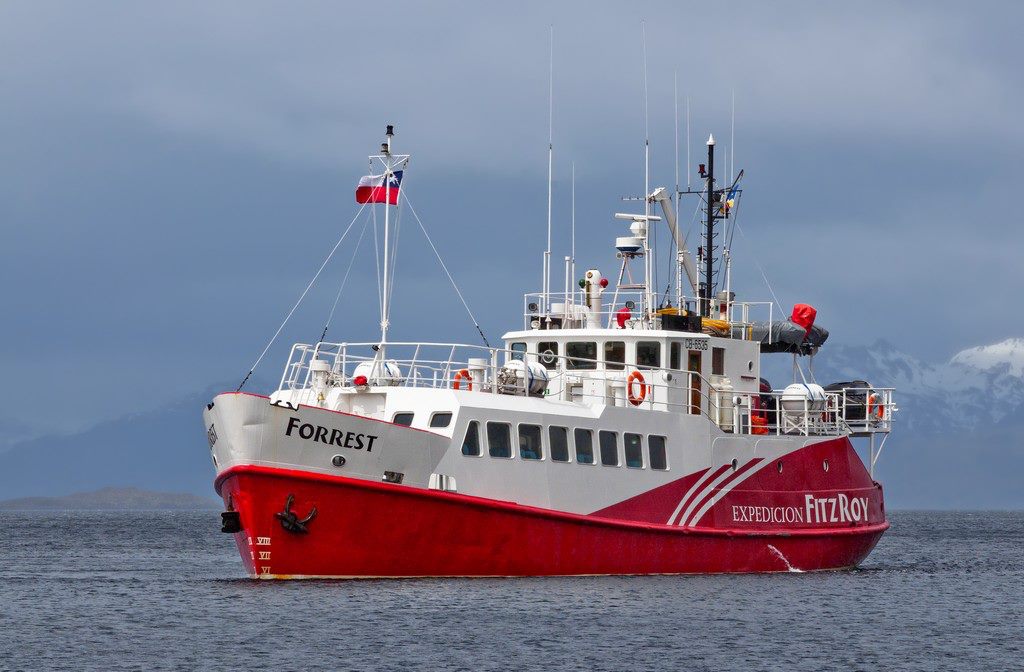
Our home on the Magellan Strait


Curious Young Elephant Seal

The time passed quickly with so many wonderful experiences and soon we were back in Punta Arenas not looking forward to our long haul back to the USPunta ArenasSantiagoBuenos AiresNewarkSan Francisco.

Last day on the Magellan Strait - finally the sun made an appearance!

But what a journey it was!!  High mountains, open seas, wildlife on land, on sea and in the air.  Seeing 8 condors taking the thermals up higher and higher was an unforgettable sight better enjoyed without the camera in front of my eyes.  What a joy to see these enormous birds with a 3 m (9ft) wingspan taking flight and soaring in the high sky.  They are not threatened in these mountains, gliding over the enormous glaciers and over the fjords and islands of this untouched land. There is a beauty in the rough landscape that tells of hardship for man and beast who try to penetrate it.  Those who survive the raw nature in this region are richly rewarded.  Since the land in the southern cold climate offers sparse, low and hardy vegetation, the seas mostly provide food for the condors, albatross, petrels, fur seals, elephant seals, humpbacks and all the other critters that make their life here.  I am thankful having been given all but a glimpse into a world quite foreign to me.  I loved having the wind blowing in my hair, happy that I did not fall into the icy waters when kayaking! - and mastering my fear of climbing on crampons over glacier crevices. 

 Moody sunset over the Magellan mountains

Now I am back home.  My camera and I were very busy during the trip – amazing that I did not get cramps in my index finger from triggering the shutter release - and I will share my images as I work through and relive my trip. 

Til next time soon,
Meggi


Comments?  I love to hear from you.  Please use my email mraeder33@gmail.com to reach me.

Sunday, July 15, 2012

Travel TidBits: Milkyway

Dark Sky over Glacier National Park

I am traveling in Montana and visited Glacier National Park this week.   The lack of light pollution and the close to new moon produced a beautiful starry night.  Luck had it that I could follow the milky way across the East-South sky on one clear night.  Since the sun only sets after 9pm and the dusk lingers for a long time, it was well after midnight when the stars fully appeared.  Having scouted out a location near a lake, I hoped for reflection of the stars in the water and was well rewarded.


I will write more about my current travel in a later blog.

Til next time,
Meggi

Saturday, June 2, 2012

Chasing the Moon


Celestial Events – Chasing the Huge Full  Moon


Full Moon over Golden Gate

In a couple of my recent Travel TidBits blogs I wrote about the annular solar eclipse on May 20, 2012 and about the super full moon rising on May 5, 2012.  I actually photographed another ‘huge’ full moon setting on the early mornings of April 6 and April 7. On those days, the moon had similar characteristics with a near earth  orbit as described in my May 5 post.  The moon only 'appears' to be ‘huge’ due to the proximity to the earth.

I have only recently started to pay attention to these celestial events but find it fascinating.  Probably a lot of us go through life without ever paying much attention to the sky specifically if you are not an outgoing night person – well I did not feel I missed anything….  But thanks to The Bay Area Night Photography Meet-up group and the Star Circle Academy, I am all of a sudden more intrigued by what’s happening in the sky and willing to stay up or even go out at an ungodly time of 3-4am to watch – not to haul with –the moon.  So this is what I did on April 6: 


It was full moon and the moon was unusually large to its near earth orbit.  It’s a complicated story how to figure out where the moon might be either rising or setting over a landmark to capture an alluring image.  But thanks to Steven Christenson of the Star Circle Academy, I knew that looking west from the Berkeley Marina the moon would set over the Golden Gate Bridge.  With the bridge about 8-10 miles away, the perspective would be such that the moon would appear large relative to the bridge.  But this also meant that a large tele lens would be necessary to capture the setting moon and bridge in that far distance.  For this shoot, I choose the Nikon D7000 camera with the cropped sensor (aiding in the further reach), Nikon 200-400mm lens at full tele, and added a 1.4 teleconverter.  This gave me an effective 825mm tele - allowing for the relative close-up considering the 8-10 miles of distance between the Berkeley Marina and the golden Gate.  The images shown here were taken at ISO 200 with the an aperture of f/7.1 and a shutter speed varying between 3-5 seconds.

Well, armed with all my equipment and tripod and bundled in down jackets and hats and gloves, my friend Lynda and I set out at ~4am on a cold morning of April 6.  By the time we reached the Berkeley Marina a lot of photographers had gathered there to observe and capture the huge moon.  It was good to be early, to select the best place and set up our equipment, and follow the moon on his descend.  As it neared the bridge, the clicking of the cameras was the only sound to be heard.  Everyone as concentrating on settings, eager not to miss the shot since the moon waits for no one.


It was a great experience and finally over a hot cup of coffee, we talked about other possibilities to capture the ‘huge’ moon.  

Well, next morning at 4am, I was on my way to the coast and hoped to photograph the setting moon over Pigeon Point.  It was a clear morning along the coast with only a cloud bank far out over the ocean.  As I set up in the dark – thanks for a camping headlamp well equipped to see what I was doing - the moon was still high in the sky on its path beyond the horizon.  … and then I noticed it that my position would not bring the lighthouse into the path – oh well, too late to change [I hadn't done the complicated calculation .... mentioned above!!] .  But look for yourself, I still had a nice view over the calm ocean, and the morning colors just before sunrise were definitely worth the early trip out to the coast.

The setting full moon over Pigeon Point


Til next time,
Meggi


~~~~~~~~~~~~~~~~~~~~~~~~~~~~~~~~~~~~~~~~~~~~~~


Looking for some fun photography outings, check this out: