Showing posts with label Climate change. Show all posts

Sunday, November 29, 2015

Shell Oil and the Arctic

How People like You Save the Arctic!

For 3.5 years, people like All of Us campaigned to stop oil giant Shell from drilling in Arctic waters. 


 Mother and cub [Copyright M. Raeder-Photography]


Finally, this year, after relentless work by many environmental organizations, Shell announced that it is ending its Arctic drilling plans!

It's been an amazing year in the fight to save the Arctic — and it's because of your action. From kayaktivist flotillas in Seattle to bridge climbers in Portland to the millions of people who signed petitions, wrote letters and called the White House, this was a victory fueled by people power. Watch the story unfold in the video below!


Peter Capaldi narrates the story of how All of Us won this monumental victory for the Arctic.


[Ref: Video by GreenPeace]


Til next time,
Meggi


                                           Mother and 2 cubs [Copyright M. Raeder-Photography]

Saturday, November 28, 2015

Birds-ClimateChange

Hyacinth Macaw


Birds tell us!

Thoughts by Lynsy Smithson-Stanley is the Deputy Director of Climate & Strategic Initiatives.
Over time and across cultures, birds have sent us warning signals about the health of our environment. Never has their message been more urgent: Birds are telling us climate change is here, and it threatens birds worldwide.


Macaw [M.Raeder-Photography]


Research shows that climate change poses grave risks to birds around the globe, and those impacts will intensify as warming continues. For instance:

·  Disappearing sea ice is already making it harder for Emperor Penguins to find food and raise their chicks.
·  For mountain-dwelling birds like the Resplendent Quetzal, rising temperatures are driving birds to higher altitudes, which can create more competition for food and suitable habitat - and there are limitation how high the birds can go, what then?
·  Changes in temperature and rainfall could make it harder for the Hyacinth Macaw and other rainforest birds.

Similar trends hold true for other wildlife that is threatened in their natural habitat by changes occurring all around the globe.
As world leaders come together next week in Paris for the Global Climate Talks to take collective action on climate change, it’s important to recognize what nature is telling us and to become aware of our collective actions, to act responsibly, and to protect our blue planet.

Macaw Feathers [M.Raeder-Photography]

Til next time,
Meggi

Monday, January 26, 2015

Warming Arctic


Little Auks Adapt to Warming Arctic

Last month I gave you a little glimpse into my experience traveling to the Antarctic.
Today, I would like to take you to the opposite pole, to the Arctic, and share some recent findings by researchers who studied the Little Auk, a small black and white bird that is a so-called sentinel species, one that can be used as a proxy for the health of an entire ecosystem, much like the polar bear.  It is a fascinating story and video involving the migration of southern krill to the northern waters as the ocean waters warm and the glaciers melt.

So by studying this little bird, that looks kind of like a flying penguin, scientists are rethinking how polar ecosystems are changing in our warming world.


Little Auks [Copyright Hopkins]

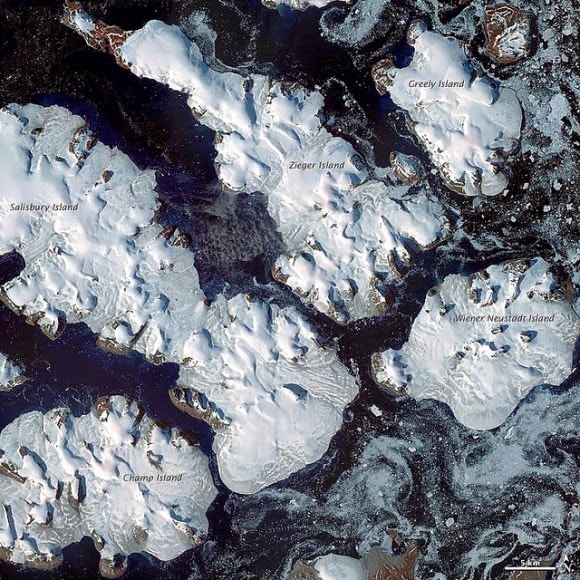
In July of 2013, a team of scientists from France, Russia and the United States descended upon an uninhabited archipelago in the Russian Arctic called Franz-Josef Land, the northern most archipelago in the world. There they spent two months at Tikhaya Bay on Hooker Island, one of the archipelago’s 191 islands, tagging and studying a small black and white seabird called the little auk (Alle Alle), which nests on cliffs and dives for its dinner in the frigid water.

Their findings call into question some models of climate change impacts on polar ecosystems, argues David Grémillet, the lead scientist of the group, in research published in Global Change Biology in mid-January.

Given its remote high-Arctic location, Franz-Josef Land has long been considered a kind of Arctic Eden, sheltered from the impacts of climate change. Nearly 85 percent of its land mass is blanketed by glaciers and its islands are surrounded by extensive sea ice. But temperatures in the Arctic are rising, and are predicted to increase by as much as 14 degrees Fahrenheit by the end of the century. Grémillet and his colleagues wanted to measure how the ecosystem of this icy Arcadia is responding.


Little Auks in Franz-Joseph Land [Copyright Cory Richards]

They chose the little auk as a subject because it is a so-called sentinel species, one that can be used as a proxy for the health of an entire ecosystem, much like the polar bear. The most abundant seabird in the Atlantic Arctic, with over 40 million individuals, the little auk is a major part of the food chain in polar ecosystems. Previous research has suggested that the little auk is quite flexible in the face of changes to its environment. But Grémillet and his colleagues suspected the bird might reach a breaking point due to its high energy costs and metabolic rate, as well as a diet primarily made up of copepods—tiny crustaceans that are themselves highly reactive to changes in sea ice and water temperature.


Using remote sensing data, the scientists measured changes in the volume and area of sea ice and glaciers between 1979 and 2013. They also tagged a number of little auks from one colony with tiny electronic devices affixed to legs or breast feathers to track their foraging behavior. These devices, called miniaturized temperature–depth recorders, provided information on the depth and duration of every dive, as well as the hours spent each day gathering food. The researchers then compared current and historical data on the diet, body weight and chick growth of little auks at Franz-Josef Land.
The data they collected revealed some bad news and some good news. The bad news: Sea ice in the Franz-Josef archipelago has, in fact, retreated markedly during the last decade, disappearing entirely during summer by 2005—a harbinger of future conditions elsewhere in the Arctic Ocean. Coastal glaciers have also retreated, dumping large volumes of meltwater into the sea. The good news: while disappearing sea ice curtailed the birds’ traditional feeding grounds, retreating glaciers created new ones. The little auks were able to adapt, feeding at the boundaries where glacier melt discharged into coastal waters at Tikhaya Bay, close to the their breeding areas. Local zooplankton were shocked by cold temperatures and dramatic contrasts in salt concentrations between the fresh meltwater and saline oceans, making them easy prey. The little auks were able to maintain chick growth weights, while adults lost just 4% of body mass.

Frozen Franz-Joseph Land, August 2011 [Copyright NASA Earth Observatory]
The little auks’ adaptability in Franz-Josef raises questions about previous research on the birds. In a 2010 paper, Nina Karnovsky of Pomona College predicted that 40% of all little auks would disappear from the Atlantic Arctic by the end of the 21st century, Grémillet and his colleagues note. They argue that this prediction must now be revisited. They also call for further study of little auks at other Arctic geographies, to see if they are as adaptable as the ones making a home at Franz-Josef Land.
The Franz-Josef little auk findings support the conclusions of other recent research on Adélie penguins in the Antarctic and seabirds and marine mammals in Alaska that suggest glacial melt can, in some cases, compensate for disappearing sea ice to support new feeding habits, benefitting certain animals within an ecosystem, according to the authors of the paper.
“There is currently a huge demand for predicting the fate of Arctic biodiversity exposed to ongoing climate change,” the authors write. “At the species level, this is achieved by building habitat models.” But if the models don’t take certain environmental interactions into account, inaccurate predictions will be made.
This article is republished by EarthSky.org [with permission from GlacierHub. This post was written by Kristen French.]
 
Til next time,
Meggi
 

Tuesday, March 12, 2013

Patagonia-Glaciers


PatagoniaLand of Glaciers and Rugged Mountains

Patagonia and the southern tip of the South American Continent has become an ‘exotic’ travel destination.  Just about 10 years ago, it was mainly a destination for trekkers and climbers that flocked to places like El Chalten near the FitzRoy massive or Torre del Paine with its rugged mountain peaks.  Now it has opened up and seems to be on the list of places offered by many tour groups.  Little towns like El Chalten sport several new hotels – or hosterias – which made more comfortable accommodations rather than tent camps available for the mainstream tourist.

Western Patagonia (Argentina and Chile) presents ragged mountains of the Andes topped by enormous glaciers,  and an ever-blowing wind even in the summer months.  The eastern regions, the arid ‘steppe’ (grasslands) is populated by ranches – estancias – with cattle and sheep.  As one travels south towards Chile the precipitation is more ubiquitous and the density of sheep increases.  It is said there are more sheep than one can count in a lifetime of sleepless nights. 

As I left Buenos Aires after a short visit I flew to El Calafate and traveled overland north to El Chalten.  It was sunset as we approached to our evening destination.  On route, the sun was setting and the FitzRoy massive with its high peaks of 11,000 ft glowed in warm colors.  These very steep mountains peaks are a paradise for climbers and not for the faint of heart. I rather marveled in sunsets and sunrises with beautiful colors (More of the FitzRoy Massive in a later Travel TidBits).


While I would see numerous glaciers during my time in Patagonia, the first 2 are memorable since I walked on ice and among the crevices of the Viedma Glacier near El Chalten and for the enormity of the Icefield of Perito Moreno Glacier part of the larger Upsala Glacier near El Calafate, both belonging to the Glaciers of the Los Glaciares National Park which was declared a World Heritage Site in 1981. 

The Viedma Glacier is part of the Southern Patagonia Ice Field (SPI) and is one of the 48 glaciers fed by the Southern Patagonian Icefield shared across the Andes by Argentina and Chile.  This icefield is the world’s third largest reserve of fresh water!

From the air one can see its terminal phase flowing into the western end of Lake Viedma which was created by the receding glacier and melting ice and its end moraine.  Its glacier terminus spans 2 kilometers wide as it enters Lake Viedma.  Moving slowly downwards chunk of ice fall into the lake and float as icebergs before eventually melting.  With the melting ice, debris of soil and rocks ground up by the moving ice are swept into the lake giving it its typical glacial green color as typical seen in glacial lakes.


The dark streaks in the middle of the glacier terminus are formed when rock debris gets intermingled with the flowing ice mass.  Due to the pressure from the above icefield and depth of the ice, the middle ice moves faster than the sides of the glacier forming the appearance of a river of ice moving towards the lake where it ends in a cliff like structure.

To reach the glacier terminus, we drove from El Chalten to Lake Viedma, where a boat awaited to take us over the lake to the ice.  

It was a gorgeous day for a boat ride and hike.


Little did I know that walking on the ice means donning crampons, climbing up and over crevices, looking down into small glacier ‘lakes’ that form in the crevices.  After landing on a barren rock we first had to hike up and thankfully, the guides had left the crampons near where the ice met the rock. 


 The boat fit snugly into a little rock cove and we disembarked over the front end onto the rock.


The view from the top onto the glacier’s end shows the mass of ice ‘gliding’ into the lake calving ice into the lake periodically accompanied by loud noise.


After being properly fitted the crampons – I had never in my life walked with crampons! - a big step brought us face-to-face with a rather unfamiliar environment.

We initially hiked up following a valley leading up to the Crevice field.


It looks like a labyrinth but thank God we had a guide who knew where the next path would be.  


The different colors of the glacier ice were amazing.  Depending on the density of the ice it can shimmer in shades of blue with grey added by the moraine debris.  The enormity of the ice field is overwhelming and we are just a speck on the ever expanding ice.


The slopes of the hills and valleys were made walking slow and our guides carved steps when the grade was too steep.


This was a new experience for me and I was at awe at nature.  The cracking noises – much louder than I ever had imagined – reminded us that we were standing on a ‘living and moving’ mountain.  The occasional loud noises sounded like canon balls exploding as the glacier face calved enormous chunks of ice into the water.  Nature was certainly at action here.

Hiking down from the crevices, unloading the crampons, climbing over the rock face and back into the boat, the day had passed by fast with so many new impressions.

[Courtesy of Dan Cox]


Thinking that one day this may no longer be available to experience made me sad.  The below image of another glacier shows how globally glaciers are receding as our climate changes.  

From USGS Archives

The USGS images span a century and this seems a long time in our life yet it is a tiny spec in Earth time.  Of the 48 glaciers of the Southern Patagonia Icefield, only the enormous Perito Moreno Glacier is fed by enough precipitation to counter balance it relentless flow to its terminus in Lake Argentina

I will show images of the Perito Moreno Glacier and Lake Argentina - another great glacier experience - in my next Travel TidBits as my journey continues.

Til then,
Meggi


Comments?  I love to hear from you.  Please use my email mraeder33@gmail.com to reach me.


~~~~~~~~~~~~~~~~~~~~~~~~~~~~~~~~~~~~~

Interesting reading:  
A study titled  “Ice Loss from the Southern Patagonian Icefield, South America, between 2000 and 2012” by the authors:  Michael J Willis, Andrew K Melkonian, and Matthew E Pritchard, Earth and Atmospheric Sciences, Cornell University, Ithaca, New York, USA [http://www.agu.org/news/press/pr_archives/2012/2012-41.shtml, 5 September 2012] observe: “The Southern Patagonian Icefield together with its smaller northern neighbor, the Northern Patagonian Icefield, are the largest icefields in the southern hemisphere — excluding Antarctica. The new study shows that the icefields are losing ice faster since the turn of the century and contributing more to sea level rise than ever before.”  Even on the highest elevations rain is more prevalent than snow which softens the ice and contributes to a more rapid downward movement.  ‘Warming air temperatures contribute to the thinning at the highest and coldest regions of the ice field, Willis said. Moreover warmer temperatures mean greater chances that rain, as opposed to snow, will fall on and around the glaciers. This double threat of warming and more rain may, in turn, change the amount of water beneath the glaciers. More water means less friction, so the glaciers start to move faster as they thin, moving even more ice in to the oceans. Rising lakes at the front of the glaciers may also play a part as they eat away at the icy edges faster, causing the glaciers to retreat even further.’


Monday, August 6, 2012

In the News: Polar Bears


Hot and Hungry

After swimming for days from the arctic ice pack, the Ice Bear arrives at Hudson Bay famished.


Please read more on the polar bears and their survival on my Travel TidBits here.